Rooming House Investment in Queensland
A purpose-built rooming house is usually five private, lockable studios under one roof, with five separate rental agreements on one title; however, depending on the site analysis, a rooming house of 300 m² or less can have up to a maximum of 12 residents in 12 private, lockable studios under one roof, with 12 separate rental agreements on one title. For the right investor it can return a higher gross yield than a standard house in the same suburb. It is also a commercial residential investment, so the finance, approvals and running costs are different.
What Is a Modern Rooming House?
From the street, a modern rooming house looks like a well-presented family home. Inside, it is designed so that each room can be let separately. In Brisbane City Council’s area, small-scale rooming accommodation is generally limited to five residents; more residents, up to 12, depend on the site, the planning scheme and approvals, and these homes are usually certified as Class 1b buildings under the National Construction Code, which covers boarding houses of no more than 300 m² and 12 residents.
- Five semi-self-contained studios, each lockable, with a private ensuite, kitchenette, living area, wardrobe and split-system air conditioning.
- A shared kitchen, living area and laundry for residents.
- Each resident signs a separate written rooming accommodation agreement and agrees to the house rules.
- The owner usually pays the power, water and internet, and the resident pays one all-inclusive weekly rent.
- Features often include smart digital locks, whole-house Wi-Fi, acoustic insulation between studios and rooftop solar.
What a Purpose-Built Rooming House Looks Like
A proper rooming house is not a family home with a lock on each bedroom door. It is designed and built so that each resident has a private, lockable studio with their own ensuite and kitchenette, plus shared common areas, all behind a street front that looks like a well-presented family home. These photos are from completed purpose-built rooming houses.
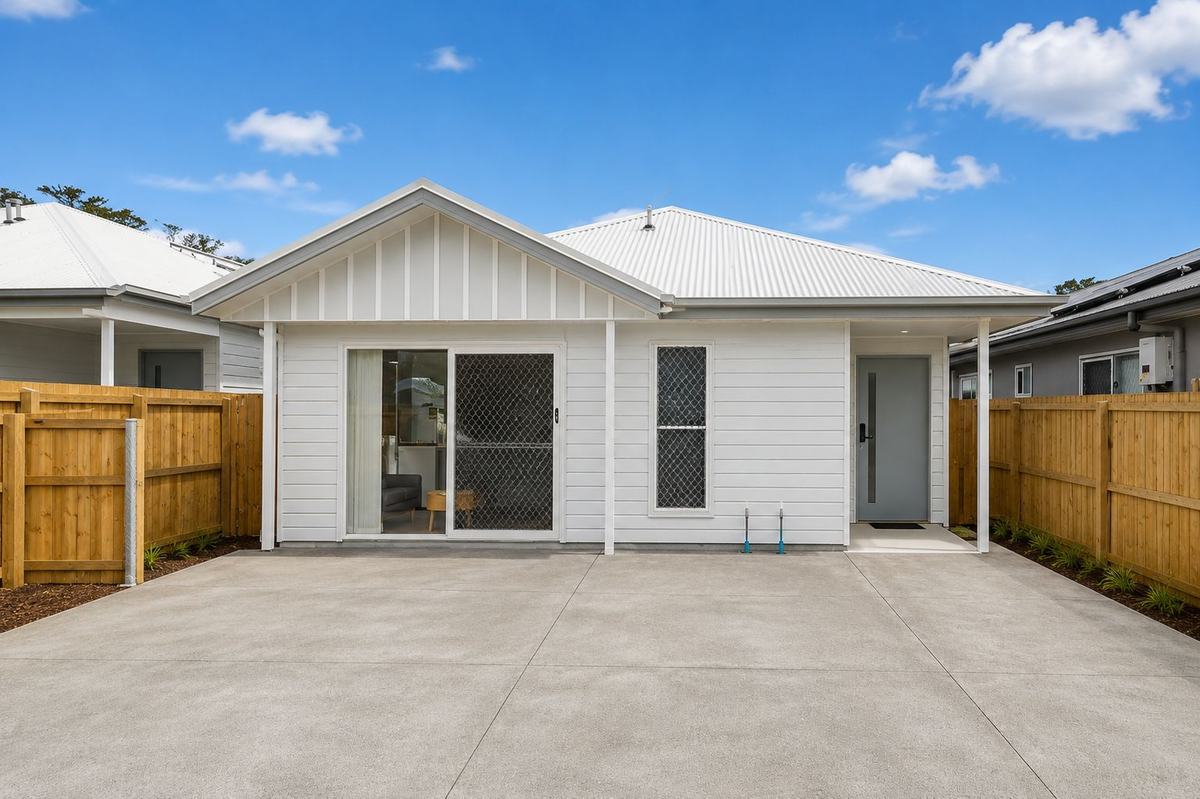
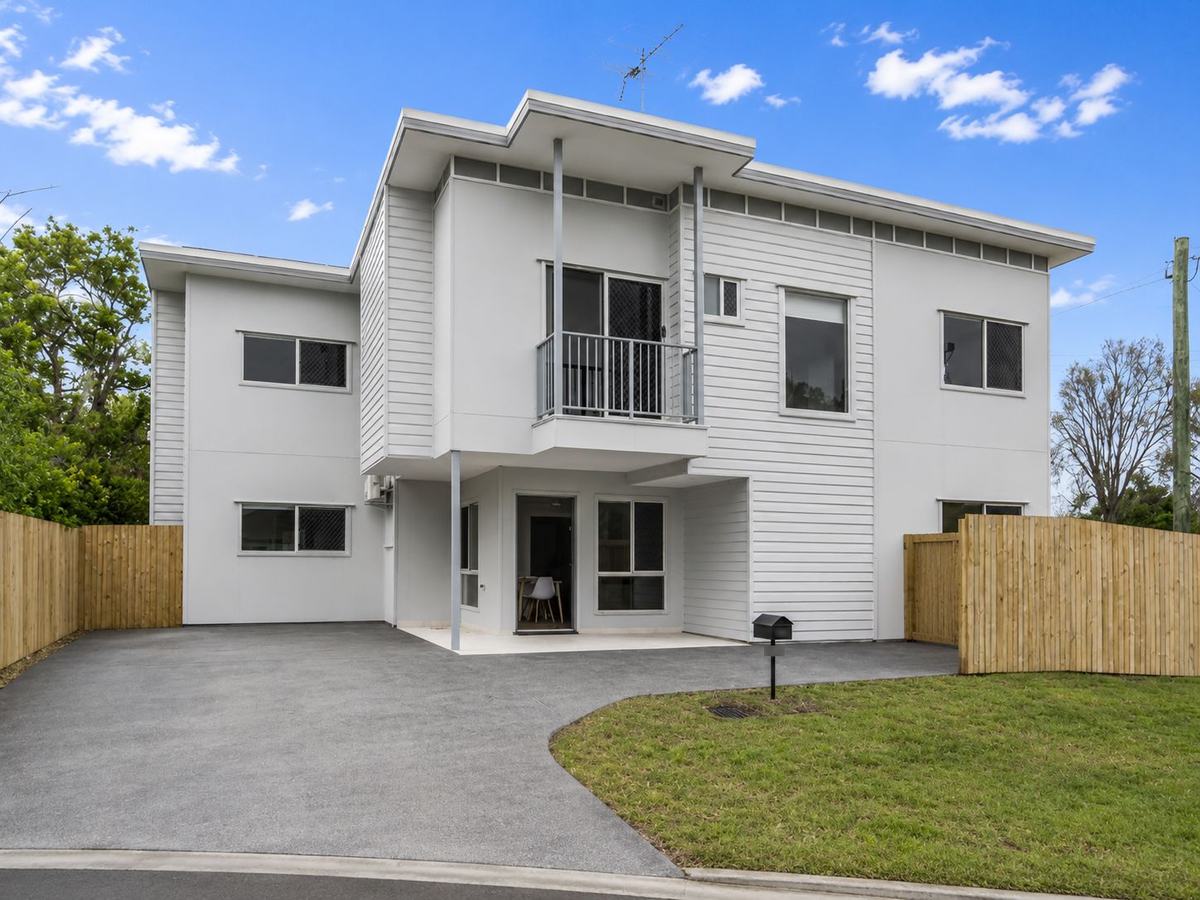
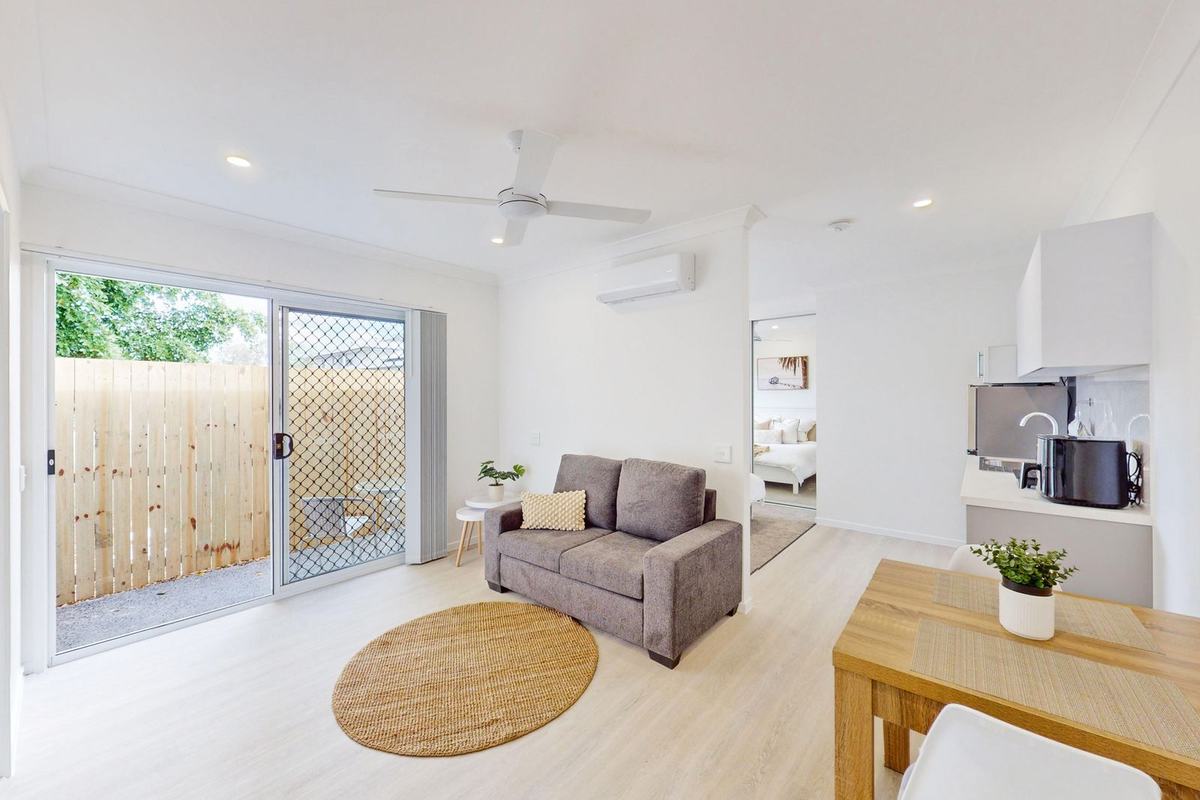
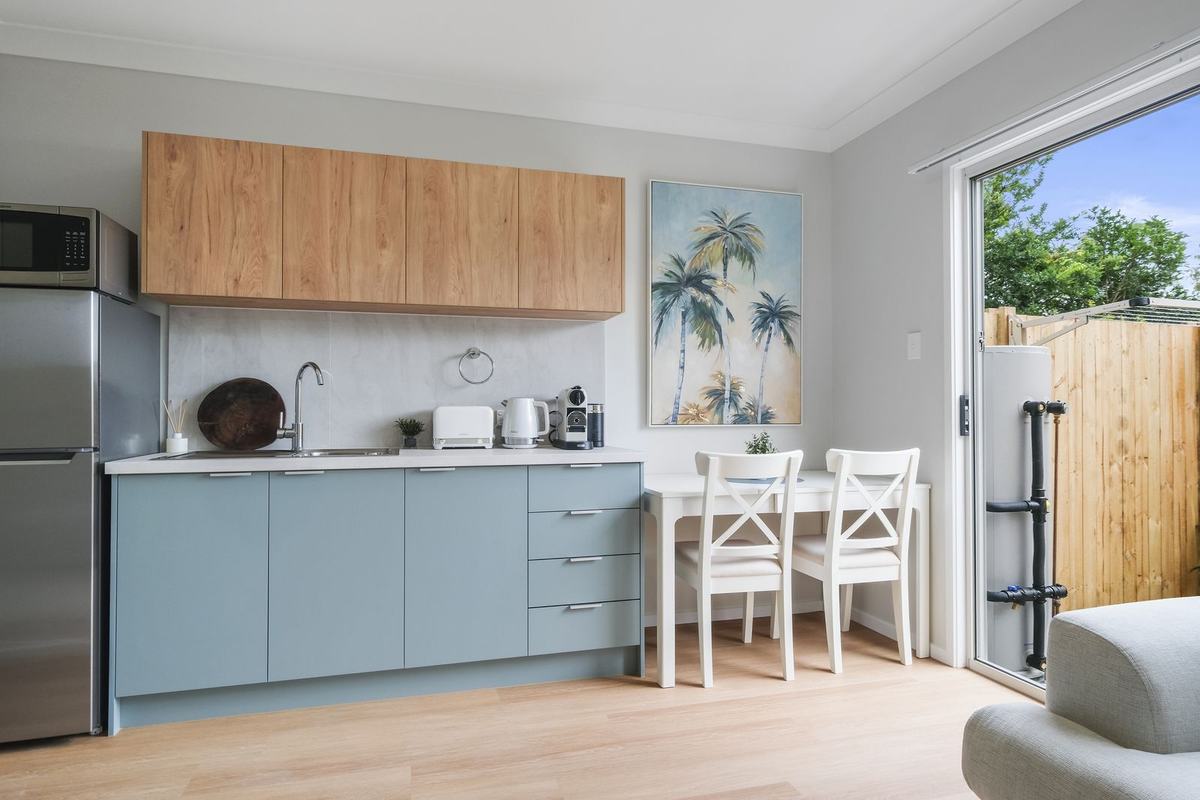
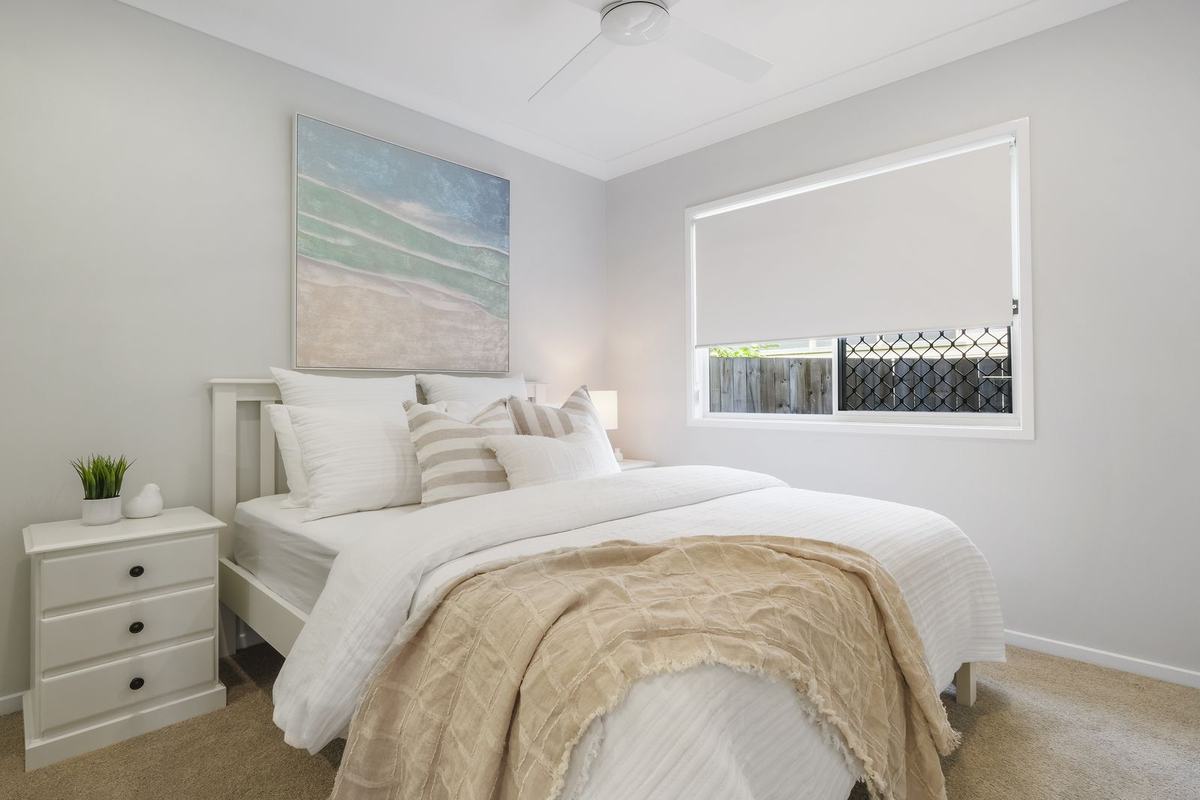
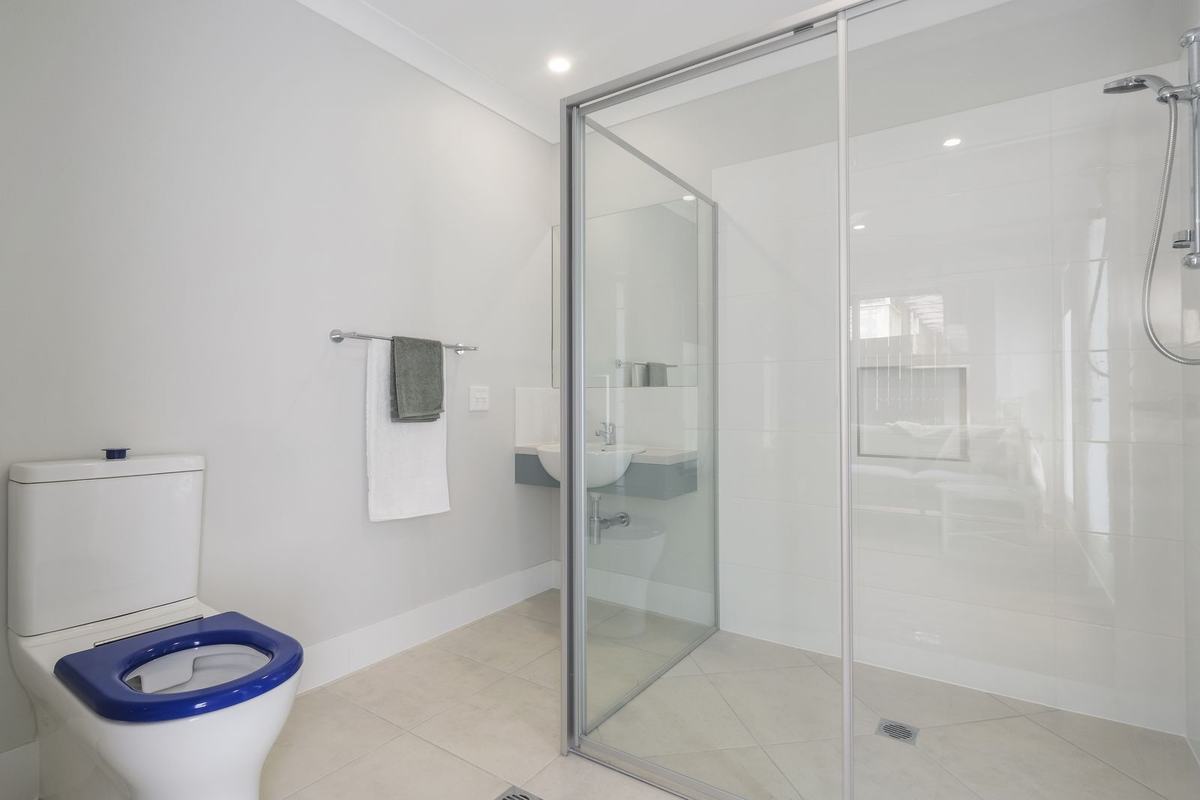
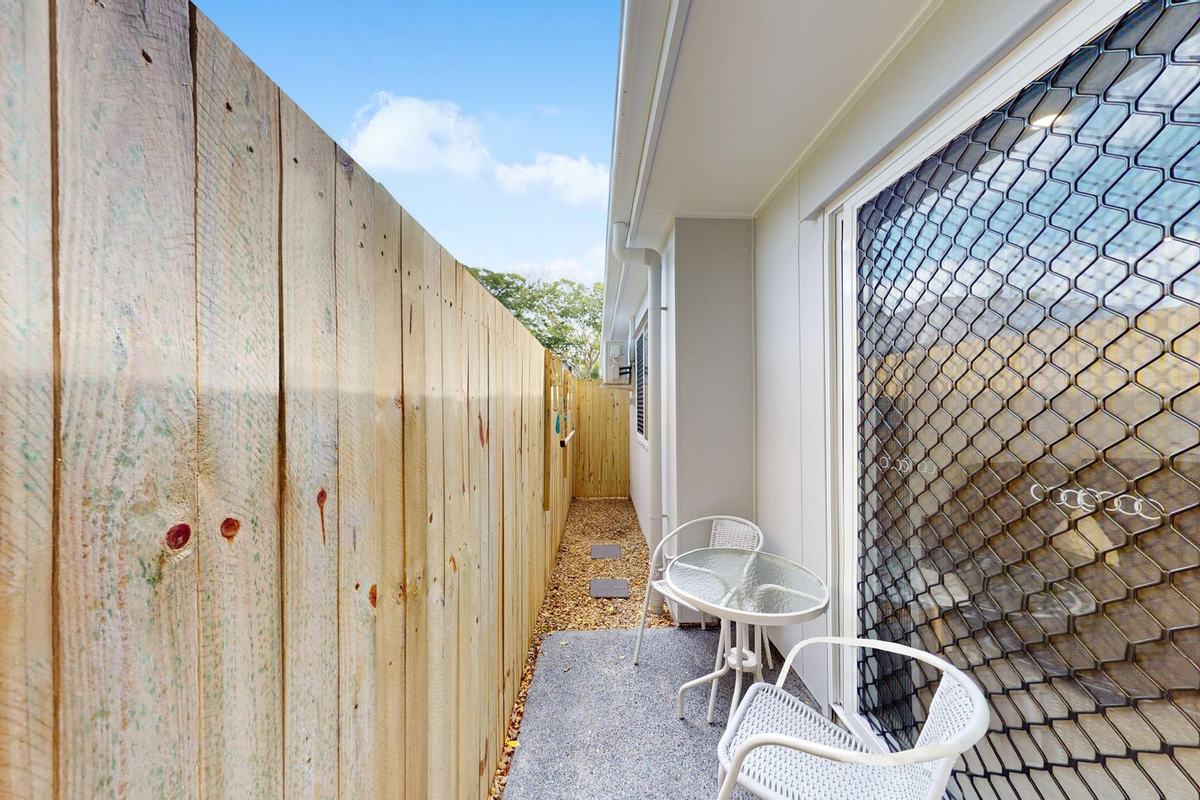
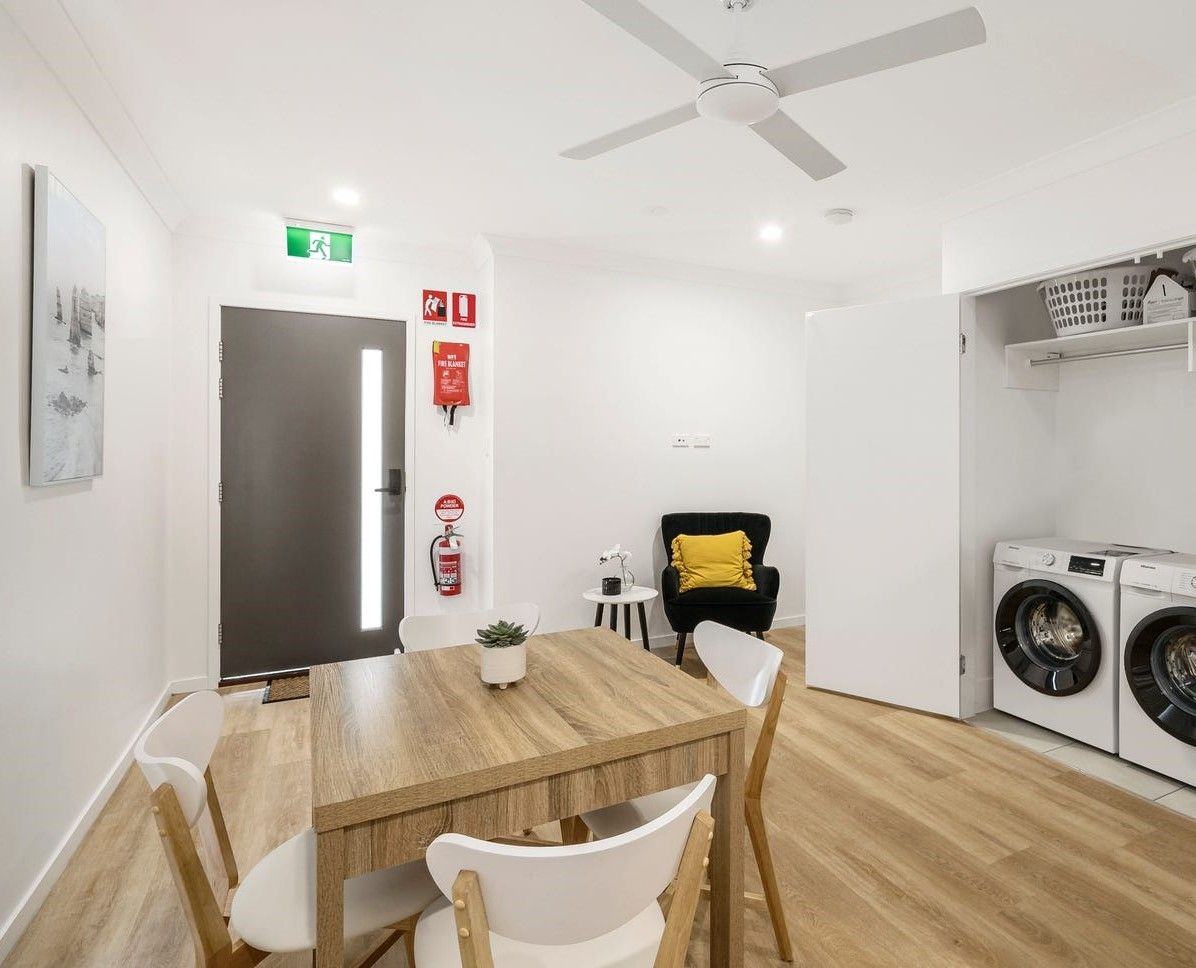
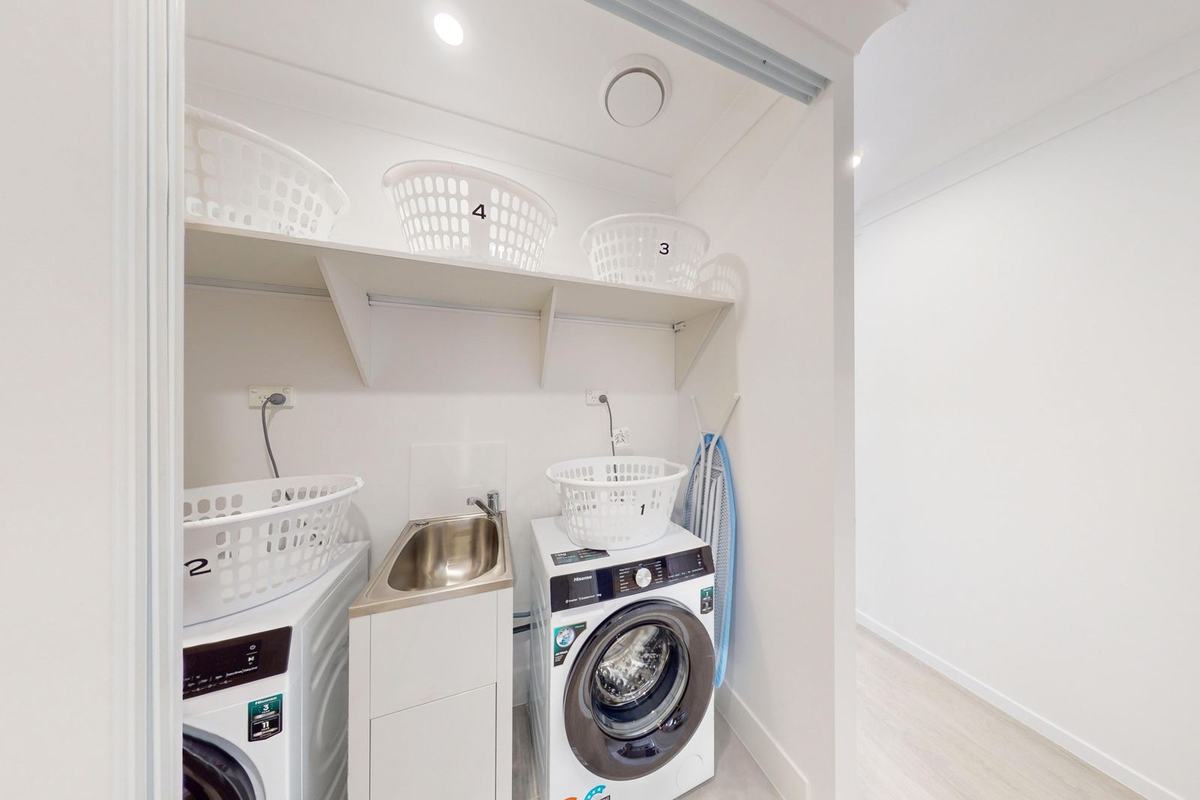
Photos are examples of completed purpose-built rooming houses and are for illustration only. Finishes, layouts and inclusions vary from one property to the next.
Why Investors Consider Rooming Houses
- Several incomes from one property: usually five separate rents (up to 12 on a suitable site), which usually adds up to more than a single lease on a comparable house.
- Vacancy risk is spread: if one resident leaves, the other rents keep coming in while the studio is re-let.
- One title, one set of rates: no body corporate levies, unlike a block of units.
- Depreciation: a new build with a full fit-out can offer significant depreciation deductions. Ask a quantity surveyor and your accountant what applies to you.
- Better use of the land: on a suitable low-density block, a rooming house can produce more income than a single dwelling.
- Demand for small, affordable homes: at the 2021 Census, 24.7% of Queensland households were people living alone, but only 4.7% of occupied dwellings had one bedroom (plus 0.5% studios or bedsitters). Source: ABS 2021 Census QuickStats – Queensland.
- Typical residents: working singles, including healthcare and essential workers, who want a private, furnished, all-inclusive home.
Case Studies — New Five-Studio Rooming Houses in Brisbane
These are recent fixed-price house and land packages for new five-studio rooming houses, based on published builder pricing current as at October 2026, with prices rounded up to the next $10,000 and weekly rents to the next $10. Gross yields are approximate and calculated from the rounded figures. Locations are shown by region only.
Case study A — Northside Brisbane
New build · 5 studios · 5 bathrooms · 3 car spaces · 405 m² lot
- Land price
- $880,000
- Build price (incl. site costs)
- $620,000
- Total package
- $1,500,000
- Minimum equity required at 35%
- $525,000
- Finance required at 65%
- $975,000
- Rent per week (all studios + car parks)
- $2,530
- Annual rent (51 weeks)
- $129,030
Case study B — Southside Brisbane
New build · 5 studios · 5 bathrooms · 3 car spaces · 450 m² lot
- Land price
- $780,000
- Build price (incl. site costs)
- $650,000
- Total package
- $1,430,000
- Minimum equity required at 35%
- $500,500
- Finance required at 65%
- $929,500
- Rent per week (all studios + car parks)
- $2,380
- Annual rent (51 weeks)
- $121,380
Case study C — Northside Brisbane (larger lot)
New build · 5 studios · 5 bathrooms · 5 car spaces · 601 m² lot
- Land price
- $750,000
- Build price (incl. site costs)
- $660,000
- Total package
- $1,410,000
- Minimum equity required at 35%
- $493,500
- Finance required at 65%
- $916,500
- Rent per week (all studios + car parks)
- $2,300
- Annual rent (51 weeks)
- $117,300
Case study D — Western suburbs Brisbane
New build · 5 studios · 5 bathrooms · 3 car spaces · 420 m² lot
- Land price
- $700,000
- Build price (incl. site costs)
- $610,000
- Total package
- $1,310,000
- Minimum equity required at 35%
- $458,500
- Finance required at 65%
- $851,500
- Rent per week (all studios + car parks)
- $2,080
- Annual rent (51 weeks)
- $106,080
Equity and finance: Equity is the minimum deposit at 35% of the package price and is in addition to outgoings and purchase costs such as stamp duty, legal fees and loan fees. The lender sets the final loan-to-value ratio (LVR), which may require more equity.
Assumptions: yields are approximate and gross (annual rent ÷ total package price, using rounded figures), before expenses and loan costs, and assume full occupancy for 51 weeks a year. Weekly rent is the combined rent for five studios plus car parking. Prices, rents and availability change, are not guaranteed and are not an offer. Stamp duty, legal, finance, furniture and holding costs are extra.
Illustrative Running Costs — Five-Studio Rooming House, Brisbane
This example, based on published figures rounded up, shows how much outgoings can reduce the return. It uses a house and land price of $1,260,000, an average rent of $450 per studio per week plus $40 a week car parking ($2,290 a week), and an assumed average occupancy of 98%.
| Rent at 52 weeks | $119,080 |
| Rent adjusted for 98% occupancy | $116,700 |
| Gross yield | approx. 9.26% |
| Gardening / cleaning | $2,350 |
| Insurance – building and landlord | $3,500 |
| Property management (9%) | $10,550 |
| Council rates and water/sewerage access (Brisbane) | $3,000 |
| Internet | $1,350 |
| Electricity (with 13.3 kW solar) | $1,100 |
| Water usage | $2,400 |
| Pest inspections and treatment | $300 |
| Fire safety and smoke alarm servicing | $450 |
| Total approximate annual outgoings (rounded) | $25,000 |
| Net income before loan costs and tax | $91,700 |
| Net yield | approx. 7.28% |
| Minimum equity required at 35% (of $1,260,000) | $441,000 |
| Finance required at 65% (of $1,260,000) | $819,000 |
Equity is in addition to outgoings and purchase costs (stamp duty, legal and loan fees). The lender sets the final LVR.
General information only. Excludes loan interest, depreciation, repairs and maintenance, furniture replacement, land tax, accounting fees and longer vacancies. Your own figures will differ.
Finance: Commercial Residential, Not a Standard Home Loan
Rooming houses are Commercial Residential property. They generally need specialised commercial finance, not standard residential mortgage finance. As a guide, investors should expect to contribute a minimum 35% to 40% equity investment, plus outgoings, to secure finance.
- AW Pearson's view: a very few lenders may accept a 25% to 30% deposit, but they are few and far between. It is much safer to plan on 35% to 40%.
- Lenders assess the income, the building classification and approvals, the borrowing entity, and your wider financial position.
- Valuations can be income-based, like other commercial property, rather than relying only on comparable house sales.
- Budget for stamp duty, legal and finance fees, furniture, insurance and holding costs during construction.
- Talk to a finance broker experienced in commercial and rooming house lending early, before you sign a contract. SMSF purchases are possible in some cases but need specialist advice.
Running Costs to Plan For
- Electricity, water and internet, which are usually included in the residents’ rent.
- Specialist landlord and building insurance for rooming accommodation, which usually costs more than standard landlord insurance.
- Specialist property management fees, re-letting costs and regular inspections.
- Fire safety and smoke alarm servicing, pest control, gardening and cleaning of shared areas.
- Council rates and charges, land tax where it applies, repairs, maintenance and furniture replacement.
- Registration and accreditation fees where the property is a registered residential service.
Capital Growth: What the Sales Evidence Shows
Until recently, rooming house growth figures were estimates. In November 2026, independent analysis by HtAG Analytics measured actual growth for the first time, using 35 repeat sales across 26 Australian properties that were already rooming houses at both sales (same room count, holds of at least two years, sales from 1992 to 2026). It compares them with the same firm's repeat-sales results for houses, units and apartments.
Swipe the table sideways to see all columns.
| Annual capital growth (repeat sales) | Sales pairs | Median | Bottom quarter (25th percentile) |
|---|---|---|---|
| Rooming houses, all holds of 2+ years | 35 | 8.41% | 3.56% |
| Rooming houses, holds of 10+ years | 10 | 6.69% | n/a |
| Houses | 286,766 | 7.60% | 5.35% |
| Units | 56,556 | 4.67% | 2.18% |
| Apartments | 15,300 | 3.58% | 1.15% |
- Long-run growth similar to houses: Across all measured holds, rooming houses grew at a median 8.41% a year (mean 9.56%), ahead of houses at 7.60%. Over holds of ten years or more the median was 6.69%, a little below houses. Over a long hold, growth has been broadly comparable to a house, and well ahead of units and apartments.
- A much bumpier ride: About one in four holding periods (9 of the 35) returned less than 3% a year, and six lost value, some over five to eight years. The bottom quarter of rooming house holds grew at 3.56% a year or less, against 5.35% for houses. When you sell matters far more than with a house.
- Income is the strength: New five-studio packages showed gross yields of 8.16% to 8.68%, against 2.64% to 3.01% for established houses in the same six suburbs (September 2026): roughly three times the income, consistent with AW Pearson's benchmark of about 8% gross.
- Valued on income, not house sales: A rooming house is priced as capitalised income, which is why one can sell for around $1.4 million where houses sell for around $800,000. Five completed sales in 2026 traded at a capitalisation rate (yield) of about 7.06%. Against new stock at 8.16% to 8.68%, that implies about 19% higher value once built and leased, but the result depends on the yield a valuer applies, so ask what exit yield any projection assumes.
- Thin resale market: Only about 456 rooming houses could be identified nationally (a floor, not a full count). Buyers number in the hundreds, not thousands, and there is no owner-occupier buyer to support prices. In sales records these properties usually appear as residential sales (often a block of units with one bathroom per bedroom), so good comparable sales can be hard to find.
AW Pearson's view: the evidence supports buying a well-designed rooming house for income, with growth broadly in line with houses over the long term, but only with a long holding horizon, comfortable finance (plan on 35% to 40% equity) and no risk of being forced to sell at the wrong time.
Caveats: 35 sales pairs is a small sample, and one more outlier could move the medians. Repeat sales include any money spent on the property between sales. Properties that never resold are missing. Several pairs are in regional and mining towns with their own cycles, and tax and depreciation are not modelled. The analysis did not measure dual key or duplex properties. Past growth is not a guide to future growth.
Source: independent analysis by HtAG Analytics, "Rooming Houses: The First Measured Numbers", version 2, 11 November 2026. Figures as published; percentages are annualised capital growth before costs and tax. General information only, not financial advice.
Rooming House vs Dual Key: the Numbers
How does a rooming house compare with a dual key property (two self-contained dwellings on one title, such as a 3-bedroom and a 2-bedroom home under one roof) at a similar price? The table below uses example figures from a 2026 case-study comparison of four South East Queensland investment properties in the $1.2 million to $1.5 million range: two turnkey dual key packages, a five-studio turnkey rooming house and a four-room rooming house. Prices are rounded up to the next $10,000 and gross yields are recalculated from the rounded prices at 52 weeks and full occupancy. Locations are shown by region only. The figures are for illustration only.
Swipe the table sideways to see all four examples.
| Example | Dual key 1 · Moreton Bay region | Dual key 2 · Logan region | Rooming house 1 · Gold Coast | Rooming house 2 · Brisbane bayside |
|---|---|---|---|---|
| Layout | 2-bed + 3-bed | 3-bed + 2-bed | 4 rooms | 5 studios |
| Price (rounded up) | $1,270,000 | $1,280,000 | $1,400,000 | $1,470,000 |
| Rent per week | $1,090–$1,140 | $1,010–$1,090 (estimate) | $2,000 (4 × $500) | $2,300 (5 × $460) |
| Gross rent per year (52 weeks, mid-point) | $57,980 | $54,600 | $104,000 | $119,600 |
| Gross yield | approx. 4.46–4.67% | approx. 4.10–4.43% | approx. 7.43% | approx. 8.14% |
| Local median house rent (per week) | $700 | $650 | $850 | $720 |
| Price above local median house price | approx. 28% | approx. 47% | approx. 11% | approx. 24% |
| Local vacancy rate | 1.0% | 2.24% | 0.7% | 0.56–0.8% |
| Local 12-month house price growth | +14.4% | +16.6% | +19.8% | +11.8% to +16.5% |
| Finance type | Standard residential lending, usually with a 20% deposit (plus purchase costs) | Standard residential lending, usually with a 20% deposit (plus purchase costs) | Commercial residential: min. 35–40% equity + outgoings | Commercial residential: min. 35–40% equity + outgoings |
| Deposit / minimum equity | $254,000 (20%) | $256,000 (20%) | $490,000 (35%) | $514,500 (35%) |
| Averages of the two examples of each type | Dual key | Rooming house |
|---|---|---|
| Average price | $1,275,000 | $1,435,000 |
| Average rent per week | $1,083 | $2,150 |
| Average gross rent per year | $56,290 | $111,800 |
| Average gross yield | approx. 4.42% | approx. 7.78% |
| Average price above local median house price | approx. 37% | approx. 17% |
| Average local 12-month growth | +15.5% | approx. +17.0% |
What the comparison shows
- Yield: The rooming house examples averaged a gross yield of approx. 7.8%, compared with approx. 4.4% for the dual key examples. For roughly 12.5% more outlay (about $160,000), they produced about twice the gross rent: about $111,800 a year compared with $56,290.
- Price against the local market: The dual key packages were priced on average approx. 37% above their local median house price, compared with approx. 17% for the rooming houses, even though the rooming houses were in higher-priced suburbs. The bigger that gap, the more the value relies on the income and the new build rather than on local house sales, so it is worth checking with a valuer.
- Growth and vacancy: Local 12-month house price growth was similar for both types (+15.5% on average for the dual key suburbs and approx. +17% for the rooming house suburbs), so in these examples the type of property did not drive growth. All four suburbs had tight rental markets, with vacancy rates of 0.56% to 2.24%. Past growth is not a guide to future growth.
- Gross is not net: Rooming house outgoings are higher, because the owner usually pays electricity, water and internet, and management, insurance and compliance are specialised. Our illustrative running-costs example takes a gross yield of approx. 9.26% to a net yield of approx. 7.28% before interest. Industry estimates are more conservative: running costs of about 2.5% of the price a year for a rooming house and about 2.0% for dual occupancy, where tenants usually pay their own utilities. On those indicative figures the net gap between the two is far narrower than the gross gap.
- Industry context for dual keys: Current Queensland listings put new dual keys from about $935,000, at gross yields of around 5.2% (up to about 6.1%), a little above the two case studies here. A dual key is one title, so the two parts cannot be sold separately, and one vacancy halves the income. Two dwellings on one lot also need the right zoning and council approval.
Example figures from case studies, for illustration only. Prices are rounded up. Rents are the published estimates and are not formal appraisals. Local median, vacancy and growth figures are third-party market data (mid 2025 to mid 2026) as cited in the case-study report, and will change. Gross yields are before outgoings, vacancy, interest and tax. This is general information only, not financial, tax or legal advice, and it does not take your circumstances into account. No income, yield or growth is guaranteed. Get independent advice before investing.
Rooming House vs Duplex: the Numbers
A duplex is two self-contained homes on one block. Depending on the approval, it can stay on one title or be split onto separate titles, so each home can be sold on its own. The comparison below uses typical or indicative ranges from Australian industry sources published in October and November 2026 (some cost figures are as at August 2026) for new and established property in Queensland. They are not case studies of particular properties and are for illustration only. Where sources disagree, the more conservative figure is shown.
Swipe the table sideways to see both columns.
| Indicative (Qld) | Rooming house (five studios) | Duplex (two homes) |
|---|---|---|
| Typical price, new build (Qld) | $1.30m to $1.69m (Brisbane) | $1.0m to $1.58m |
| Rent | About $2,300 a week on a $1.4m example | Two household rents: implied about $960 to $1,520 a week at approx. 5% gross |
| Gross yield | About 8% for a proper five-studio build (AW Pearson's current benchmark). New Brisbane listings approx. 8.3% to 8.7%; established indicative 7.0% | Approx. 5% around Brisbane, up to 6.9% in regional Qld |
| Running costs | Owner usually pays utilities. Management typically 7% to 9% of rent. Indicative about 2.5% of the price a year | Tenants usually pay their own utilities. Indicative about 2.0% of the price a year |
| Net yield, before interest | Indicative approx. 4.5% (our illustrative new-build example: approx. 7.3%) | Indicative approx. 4.2% (dual occupancy) |
| Deposit and finance | Commercial residential finance. Plan on 35% to 40% equity plus outgoings (a very few lenders accept 25% to 30%). Paid valuation from about $2,000; establishment fee around 1% of the loan | Standard residential lending, usually a 20% deposit plus purchase costs |
| Cash to get started (indicative) | About $614,000 at 35% or $684,000 at 40% on a $1.4m property (deposit plus indicative duty and costs) | From about $234,000 on a $900,000 dual-occupancy property at 20% |
| Management | Individual agreement per room, higher turnover, specialist manager recommended | Two standard tenancies, usually families or couples, lower turnover |
| Compliance and approvals | Class 1b building, rooming accommodation agreements, fire safety, registration and accreditation for 4+ residents, council planning rules | Right zoning and council approval for two dwellings; standard tenancy law; no special ongoing compliance |
| Titling and resale | One title; buyers are mainly investors (about 456 identifiable rooming houses nationally); valued on its rent | If separately titled, each home can be sold on its own, including to owner-occupiers; on one title, only as a whole |
| Vacancy and risk | One empty room is about 20% of the income; little published vacancy data | One empty home is 50% of the income; residential vacancy about 0.9% to 1.7% (mid 2026) |
What the comparison shows
- Income: In AW Pearson's view, a proper rooming house (five self-contained studios, not glorified bedrooms) currently returns about 8% gross. With today's land and build costs, 12% yields are generally no longer available, which is why advertised yields of 8% to 12% or more deserve caution. A duplex around Brisbane returns approx. 5%: at $1.4m, about $2,300 a week against roughly $1,350.
- Net is much closer: Once running costs are counted, the gap narrows sharply. One industry estimate puts net yield before interest at approx. 4.5% for rooming and approx. 4.2% for dual occupancy, and approx. 3.5% against 3.2% after the extra interest margin specialised lending can carry. New, efficient builds can do better, so always ask for a full net estimate.
- Entry cost: A rooming house needs commercial finance and 35% to 40% equity, while a duplex usually needs a 20% deposit on standard residential lending. Indicative cash to get started is about $614,000 to $684,000 for a $1.4m rooming house at 35% to 40%, against about $234,000 for a $900,000 duplex or dual occupancy at 20%.
- Resale and flexibility: A separately titled duplex can be sold one home at a time, and owner-occupiers buy duplex halves, which widens the market. A rooming house sells mainly to investors from a small national pool and is valued on its rent, so its value moves with rents and interest rates.
- Risk: Each duplex vacancy costs half the income, against about a fifth for one empty room in a five-studio rooming house. Rooming houses carry more compliance risk, and sales evidence shows about one in four rooming house holds grew less than 3% a year.
Typical or indicative ranges from Australian industry sources published October to November 2026 (some figures as at August 2026), for illustration only. Running-cost, net-yield and cash-to-start estimates are for Queensland and New South Wales combined; regulatory examples from other states, such as Victoria, have not been used. Deposit: a very few lenders may accept 25% to 30% for a rooming house, but they are few and far between; AW Pearson recommends planning on 35% to 40%, and all cash figures here use that. Implied duplex rents are our calculation from the quoted yields. General information only, not financial, tax or legal advice. No income, yield or growth is guaranteed.
What This Means for Investors: Rooming House, Dual Key or Duplex?
No single option is best for everyone. Rooming houses lead on gross income, dual keys offer two incomes on one title at the lowest entry price of the three, and duplexes balance income with resale flexibility. After running costs, net returns are much closer than the gross yields suggest, and sales evidence shows rooming houses have grown broadly in line with houses over long holds, with a much wider spread of outcomes. Your equity, time horizon and appetite for management matter more than the advertised yield.
Rooming house
- Highest income: about 8% gross for a proper five-studio build in AW Pearson's view; 12% is generally no longer achievable.
- Commercial residential finance: plan on 35% to 40% equity plus outgoings; the very few lenders that accept 25% to 30% are hard to find.
- Growth broadly in line with houses over long holds, but about one in four holds grew under 3% a year and resale buyers are few.
- Suits investors with substantial equity and a long horizon who are comfortable with specialist management and compliance and will not need to sell in a hurry.
Dual key
- Two incomes on one title, from about $935,000 new; approx. 4.1% to 5.2% gross (up to about 6.1%).
- Standard residential lending, usually a 20% deposit plus purchase costs: about $254,000 to $256,000 in our case studies.
- Two standard tenancies; the two parts cannot be sold separately, and one vacancy halves the income.
- Suits investors with less equity or earlier in their portfolio who want more income than a standard house with simple management.
Duplex
- Two homes on one block, about $1.0m to $1.58m new; approx. 5% gross around Brisbane, up to 6.9% regionally.
- Standard residential lending, usually a 20% deposit plus purchase costs.
- If separately titled, each home can be sold on its own, including to owner-occupiers; you could also live in one and rent the other.
- Suits investors who want a balance of income, growth and resale flexibility with familiar residential finance.
Bottom line: choose a rooming house if income is the priority, you have the equity for commercial finance and you can hold for the long term through flat periods. Choose a dual key for the lowest entry cost with two incomes, or a duplex for income plus resale flexibility, both usually on a 20% deposit. Before you decide, compare the net numbers for your situation, after outgoings, interest, depreciation, land tax and income tax, with your accountant and a finance broker.
Case-study figures and industry ranges are for illustration only. Past growth is no guarantee of future growth. General information only, not financial, tax or legal advice; it does not take your circumstances into account. Get independent advice before investing.
Queensland Rules — Current as at November 2026
Planning (changing 2 December 2026). Until the end of 2 December 2026, the Planning Regulation 2017 stops councils from requiring a planning (material change of use) approval for qualifying small rooming houses: Class 1 buildings with no more than 5 bedrooms and 5 occupants, in general, low density or low-medium density residential zones, that meet the other conditions. That temporary state provision then expires. From 3 December 2026, each council’s planning scheme decides whether a development application is needed. Approvals given before 3 December 2025 keep transitional protection if the use starts within two years after the building work is completed. Brisbane and Ipswich currently have their own pathways for small, compliant rooming accommodation, and Gympie’s draft new planning scheme is open for comment. Always check the zone, overlays and planning scheme for the specific lot. Sources: Queensland Government – Planning; Planning Regulation 2017, s 16(2) and sch 6; Brisbane City Council – Rooming accommodation.
Building and fire safety. Rooming accommodation usually needs Class 1b (or Class 3 for larger buildings) certification, with interconnected smoke alarms, emergency lighting and exits as required. Converting an existing house brings in extra fire safety requirements, so always get advice from a building certifier. Sources: Building approvals for rooming accommodation fact sheet; Queensland Fire Department – Budget accommodation.
Tenancy law. The Residential Tenancies and Rooming Accommodation Act 2008 requires a written Rooming accommodation agreement (Form R18) with each resident. Changes from 2024 and 2025 include fixed-price advertising, the standard R22 application form, limits on the personal information that can be collected, 24 hours’ notice of entry for cleaning and 48 hours’ notice for other entry, and disclosure of benefits from rent payment methods. Source: Residential Tenancies Authority – Rental law changes.
Registration and accreditation. Accommodation for 4 or more residents who rent individually and share facilities may be a “residential service” under the Residential Services (Accreditation) Act 2002. It must then be registered before it operates and accredited at Level 1 or higher. Source: Business Queensland – Registering a residential service.
GST and tax. The ATO can treat boarding houses and similar properties as “commercial residential premises”, which changes the GST position on buying, selling and renting. Depreciation and land tax also need to be considered. Get advice from your accountant or tax adviser before you buy. Source: ATO – Commercial residential property.
How Allan Can Help
- Sourcing suitable land and new-build rooming house packages from experienced Queensland rooming house builders.
- Buying and selling established, compliant rooming houses.
- Checking cash flow, outgoings and realistic vacancy assumptions before you commit.
- Introductions to commercial finance brokers, town planners, building certifiers, quantity surveyors, insurers and specialist rooming house property managers.
- Personal service from a Queensland agent in real estate since 1989, available by appointment 7 days a week.
Frequently Asked Questions
Is a rooming house the same as an old-style boarding house?
Legally, both are rooming accommodation. Modern rooming houses, however, are high-quality, semi-self-contained studios aimed at working singles, more like small apartments than the boarding houses of the past.
Can a rooming house be converted back to a standard home?
Often yes. Moving from Class 1b back to a Class 1a dwelling is usually simpler than the reverse, because Class 1a has fewer requirements. Check with a building certifier first.
Can I sell a rooming house?
Yes. Rooming houses are sold like other investment property, often to buyers looking for income. Buyers will want to see the rent roll, the outgoings and the approvals.
Do I have to use a particular property manager?
No. We recommend a manager experienced with rooming accommodation, because of the separate agreements, house rules and compliance tasks involved.
Can I use a standard home loan?
Generally no. Rooming houses are commercial residential property and usually need specialised commercial finance, with a minimum 35% to 40% equity contribution plus outgoings.
Are the returns guaranteed?
No. The case study yields are gross, before expenses, and assume full occupancy. Actual returns depend on location, rents, vacancies, costs and interest rates.
Important Information & Regulatory Notice
This page is general information only. It is not financial, legal, tax, town planning or building advice, and it does not take your personal circumstances into account. Figures are drawn from published builder pricing and examples, and from the cited government sources. They are a guide only and may change. No rental income, yield, valuation or capital growth is guaranteed. Whether a particular property can lawfully be used as rooming accommodation depends on the lot, the building, council approvals, registration and current law. Before buying, building, converting or operating a rooming house, get independent advice from a licensed finance broker or lender, your accountant or tax adviser, a solicitor, a town planner and a building certifier.
Allan William Pearson LREA 4336779 · AW Pearson Pty Ltd ABN 73 647 648 208, Qld licence 4963637 · in conjunction with eXp Australia Pty Ltd licence 4328675.
Privacy: AW Pearson Privacy Policy · eXp Australia Privacy Policy
How Can Allan Assist You?
Tick one or more areas below and share a few details. Allan will respond personally by phone, WhatsApp or email — 7 days a week by appointment.
Talk to Allan — 7 Days a Week by Appointment
Call or WhatsApp 0418 661 125, or email allan.pearson@expaustralia.com.au / allan@awpearson.com.au. Allan answers his own phone and meets clients by appointment 7 days a week (including after-hours by arrangement).